
Abducted, sexually assaulted, starved, forced to be soldiers and miners: this is the reality for Congolese children and has been for years. Decades of conflict led children in Congo to be out of school, highly at risk of contagious diseases, and extremely malnourished: this is one of the most prolonged humanitarian crises according to the Congo Children Trust.
Children are forced to give up their life and future, being trafficked to work as soldiers or in the country’s renowned cobalt mines. But we can still help them and give them a chance at a better life.
The humanitarian crisis
The Democratic Republic of the Congo is one of the richest countries in terms of natural resources, globally, the DRC produces 70 per cent of cobalt and 60 per cent of coltan, which are essential materials used in the production of lithium batteries, microchips, capacitors and technological tools.
This wealth makes Congo a vulnerable country, exposed to external and internal interferences, wars and humanitarian crises.
The DRC has almost never known lasting peace due to its colonial past, but the conflict that has most dramatically shaped the country’s current situation began in 1994, with the Rwandan genocide, one of the bloodiest events of the twentieth century, which led to the deaths of 1 million people in just 100 days. Yet the crisis has remained largely invisible to the rest of the world.
The weakness of state institutions and the violent competition for control of mineral resources have led to an ongoing conflict in which, there are over 6 million victims, 5.7 million internally displaced people and 60 million people living in extreme poverty.
The Democratic Republic of the Congo is facing one of the world’s most serious humanitarian crisis: 25.4 million people are in need of immediate assistance, of whom 14.2 million are children, a figure higher than in any other country in the world, reflecting the fact that 50% of the population is under the age of 15.
In the country, children and teenagers are often the ones paying the highest price for one of the world’s worst humanitarian crises, as the lack of protection both from the state and from other entities, leaves them exposed to hunger and homelessness, making them targets for armed groups or victims of all kinds of exploitation, from forced labour in mines to the tragic trafficking of people for sexual exploitation and organ harvesting.
Child labour: the crisis in the Democratic Republic of the Congo
Children in DRC are also trafficked to mine in the region’s extensive cobalt and copper mines, making them slaves to child labour before they can even comprehend it. The hands of 40.000 children mine these minerals everyday, relying on these dangerous, unpaid labour to feed their families.
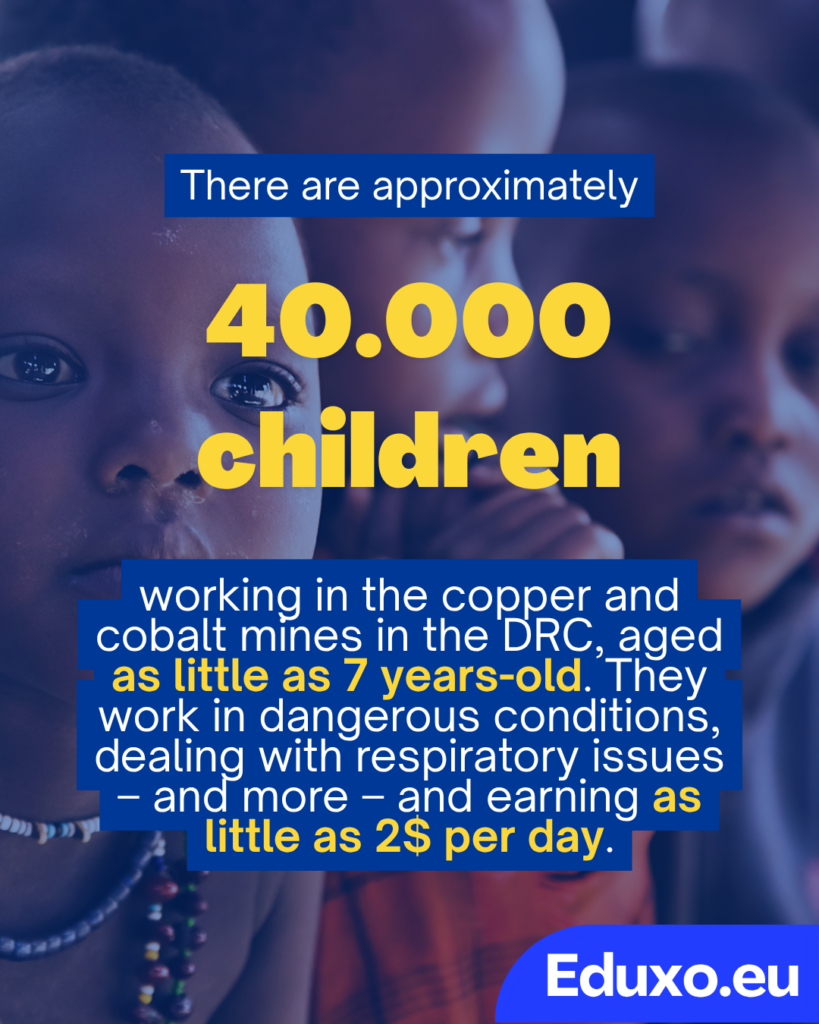
But, of course, this is not their choice. Working in a hazardous mining environment, carrying heavy loads, cleaning cobalt ores with bare hands without any sort of equipment, all while earning as little as 2$ per day, is not something someone chooses willingly, especially as a 7 years old. Many children enter mining through coercion, or due to poverty, trafficking, or family survival strategies.
Even if they weren’t unwillingly put into this modern slave trade, child miners are still coerced to join this business: cobalt and copper mining is the highest paying job in the region, and children are pushed to work in the mines to cover for the family’s basic needs. Whole families are basically forced to put their health at risk to mine cobalt and copper due to the role that these minerals play in our technology-focused society.
Cobalt is found in basically most of the tech devices that we use everyday, all day. Every lithium-ion rechargeable battery on our planet – the one in your smartphone, or your PC – is composed of cobalt compound, likely harvested with child labour.
Due to our society becoming more and more consumeristic, we are passively hurting children: they show respiratory illness symptoms due to the dust and pollution in the air; they are exposed to poor water, chemicals, and potential mine tunnel collapses; even sexually transmitted diseases are a risk in Congo’s cobalt mines, and healthcare is not easily accessible, especially for children.
Children in the Democratic Republic of the Congo are abused, enslaved, malnourished, sexually assaulted, at high risk of respiratory diseases and STDs, and also have a minimal chance of attending school, since it would mean less hands at work for the family.
Ways to help: they deserve a better future
Yes, we are buying and/or using phones, laptops, airplanes, and electric vehicles, contributing to this contemporary slavery, but i individual consumers are not solely responsible for global supply chains, but we are not powerless.
Not many know about the Rwandan genocide, the sexual exploitation and organ harvesting, the children force to be slaves in cobalt mines and the risks they take everyday just to survive awareness is the first step when addressing a crisis. Share content about Congo on social media to raise awareness about the Congolese humanitarian crisis, also aggravated by the Ebola outbreak.
Sharing this crisis makes it more known and widespread, helping organisations and institutions to reach out to help children and families in need in Congo.
Donating to organisations like Congo Children Trust helps children get structural help that can change Congolese children’s lives for the better. Their mission is simple but radical: to protect, nurture, educate, and empower the most vulnerable children in DRC. Help their cause here.
Eduxo also cares about children’s future: through advocacy actions, we give people in need a way to be heard and a voice to speak up.
Article by: Marianna Ramelli and Francesca Accili