
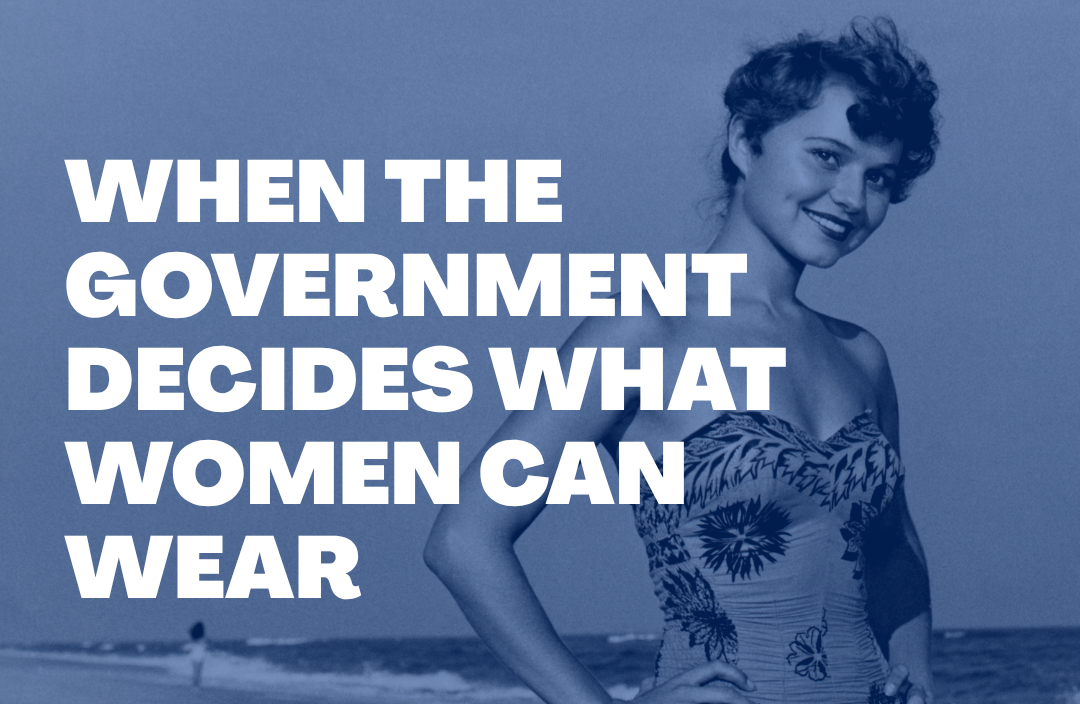
What parts of her body should a woman show when she goes swimming? For over a century, governments and local authorities in Europe and elsewhere have often felt they had to response at this question. Whether it involves forcing women to cover up or ordering them to bare more skin, regulating women’s swimwear is nothing new.
To understand the current restrictions on swimwear, we need to look back in time. Government regulation of women’s bodies at the beach has a long history.
From measuring tapes to the burkini
In the 1920s and 1930s, police officers patrolled beaches in Europe and the United States, armed with measuring tapes, to ensure that women’s swimsuits were not too short. If a woman showed too much of her legs, it was considered as a violation of public decency. When the modern bikini first appeared in 1946, it was immediately banned on beaches in countries such as Italy, Spain, and Portugal on the grounds that it was “immoral.” We have gone from the era of the “itsy-bitsy teeny-weeny bikini” to that of the “big, too big burkini.” Yet the obsession with controlling what women wear remains the same.
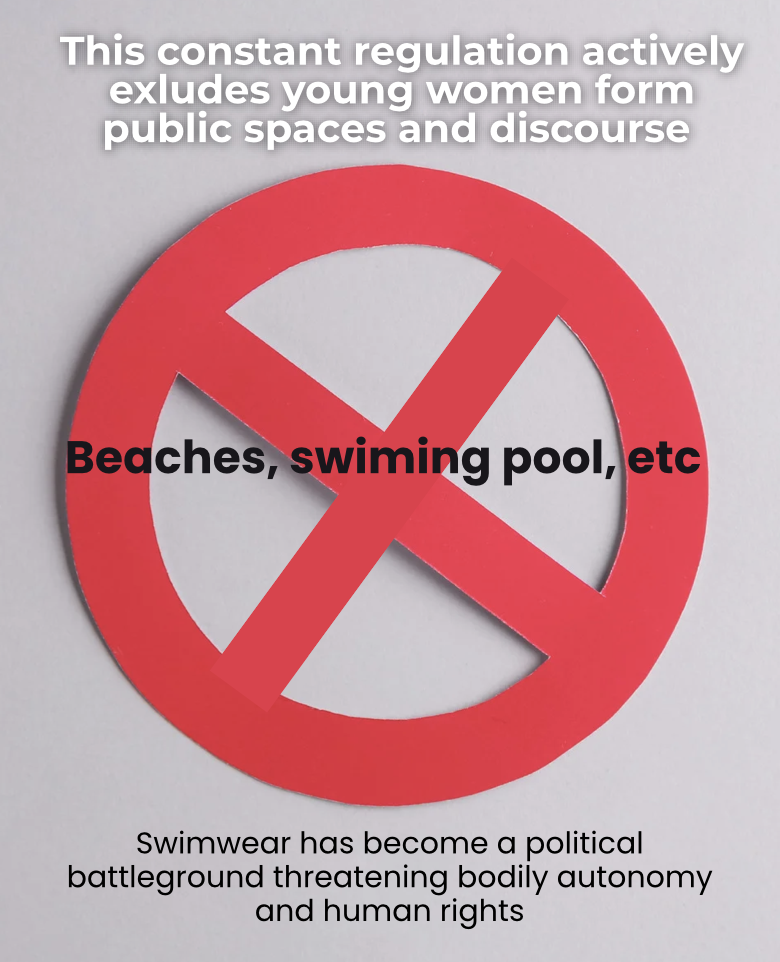
The burkini itself was actually invented in 2004 by Australian designer Aheda Zanetti. Her goal was purely inclusive: to allow Muslim women to participate in Australia’s vibrant beach culture and join official lifesaving clubs. It was designed as a tool for freedom, sports, and integration. Today, the trend has reversed. In Europe, women who wear one are forced to pay a fine or denied access to public swimming pools and beaches not because they are wearing too little fabric, but because they are wearing too much. In France and Belgium, local council have tried to ban the burkini on beaches, even though the rules of French and Belgian public swimming pools already prohibit full-body swimsuits. The problem remains the same: it is still the state that decides what a woman can and/or cannot wear?
The heart of the matter: freedom, health and inclusion
Modern regulations on swimwear pose major challenges in terms of equality, democracy, and human rights. First, current restrictions on the burkini are often justified by French and Belgian authorities in the name of “secularism” (keeping religion out of the public life), hygiene, or water safety. For example, French courts have affirmed bans in swimming pools because, in their point of view, allowing religious clothing undermines the neutrality of public services.
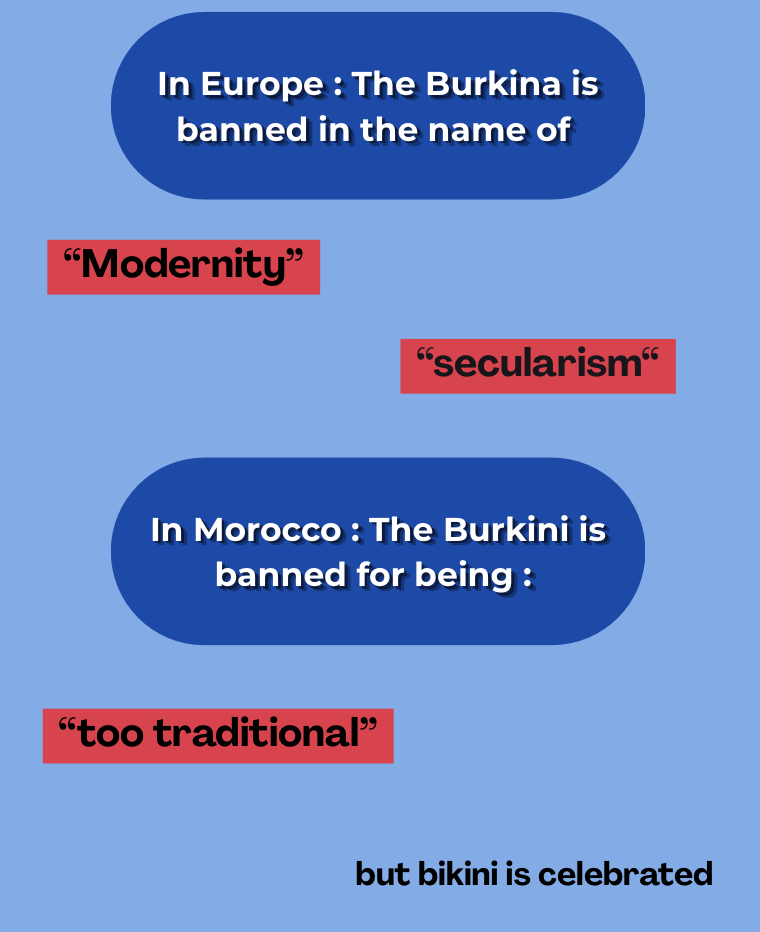
Why is this important? This exclusion has a devastating impact on individuals and communities, creating a strange global paradox. In Europe, the burkini is banned in the name of modernity and secularism. Meanwhile in certain private luxury resorts in Morocco, the bikini is celebrated as “respectable” and modern while the burkini is banned because it is deemed too traditional or reserved for the working class. Whether in Europe or North Africa, it is always institutions that decide what makes a woman “acceptable” in a public space.
However, in countries like Tunisia, many secular feminists do not view the burkini as a symbol of freedom, but rather as a step backward toward patriarchy. For women who have fought for decades for the right to reveal their bodies in the face of religious conservatism, the normalization of full-coverage swimwear can be seen as a step backward. These two opposing views show that swimwear has become a political battleground masking deeper anxieties related to identity and gender.
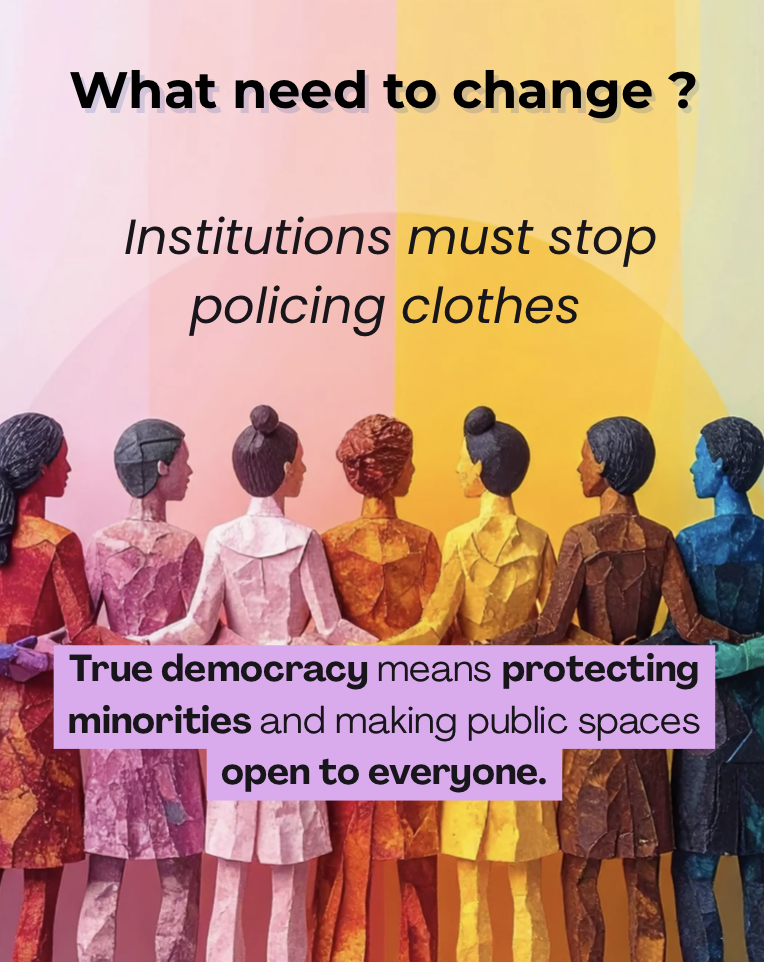
What needs to change? Institutions and city councils must stop focusing on controlling what people wear and instead focus on ensuring equality. If an item of clothing is safe and hygienic, it should be allowed. Civil society and young activists have a major role to play in this regard by refocusing the debate on human rights and bodily autonomy. True democracy means protecting minorities and ensuring that public spaces are truly public that is and open to everyone.
Equality and Civic participation
At Eduxo, we combine democratic vitality, civic education, and inclusion. Building a shared future is simply impossible if we continue to actively exclude certain young women from public discourse and public spaces.
This issue strikes at the very heart of gender equality, non-discrimination, and fundamental European values. Gender equality means supporting a woman’s right to choose her appearance, whether that means wearing a bikini, a burkini, or any other style in between. By advocating for inclusive policymaking, we can ensure that young people feel safe, heard, and valued within their communities.
The path leading from the ban on bikinis to the ban on burkinis reveals a disturbing historical continuity. Women’s bodies are constantly treated as “problematic” but they are also a battleground where political forces clash. Whether under the pretext of protecting “public morals” in the 1920s or defending “secularism.” Today the result is the same: restricting women’s freedom of movement and choice.
What women wear should be a personal choice, not something imposed on them. Women should be free to wear whatever they want without being subject to religious constraints, family pressure, or societal dictates. They should have a choice. Whether it’s a bikini or a burkini it’s the same fight!
No one is forced to like what others wear, but no one can forbid it.
True social change will only happen when we stop focusing on what women wear and start paying more attention to their right to find their place in society. The next time you see a debate about swimwear in the news, ask yourself this question: Are we enforcing public standards, or are we just policing women’s bodies?
Article by: AlixAnn Dumetz.
Lascia un commento