
The word “youth” is traditionally synonymous with a carefree life, big projects, dreams, and travel. Today, however, young people’s vision of the future is no longer so light-hearted and exciting. When they think about what lies ahead, they are met with anxiety and a fear of tomorrow. For millions of young people around the world, choosing not to plan their future is actually a realistic response to the climate crisis. Nowadays, looking ahead feels more like facing a dead end than a world of possibilities.
What is climate anxiety?
Climate anxiety is not just a simple fear of global warming or a temporary panic after watching a documentary or a film. It is a mix of complex emotions, including sadness, anger, and a deep sense of powerlessness. Climate anxiety is a form of chronic distress linked to the state of the planet. It is a healthy, empathetic, and clear-headed reaction to a world that is being damaged.
Who is affected and how?
In reality, every generation is worried, but Generation Z (those aged 15–30) feels the most affected. This is because they are the ones who will live through the second half of the 21st century. They have inherited an economic and ecological system that is running on empty. As a result, they find themselves having to fix a broken world just as they are entering the job market.
Fearing tomorrow’s climate has become the norm for young people. With record-breaking heatwaves year after year and increasingly alarming IPCC reports, reality has caught up with theory. Climate anxiety is highly relevant right now because it hits young people at the exact moment they need to make crucial life decisions: What should I study? What job will I do? How can I decide on my future when the world around me is slowly dying?
If younger generations are paralyzed by fear and anxiety, the whole of society grinds to a halt. If young people give up, it means they will stop engaging, stop voting, and the future will be lost. This is where the phrase “no future without choice” takes on its full meaning. Democracy relies on the ability of its citizens to choose their own destiny. If climate disruption and political inaction continue, young people’s freedom of choice will simply disappear. Climate anxiety is not just an individual bout of the blues; it is a political wake-up call.
What is the problem?
Faced with climate uncertainty, making long-term plans becomes a risky gamble. The very notion of choice is slowly fading away. The future, which should be seen as a blank page, is instead perceived as an imminent threat.
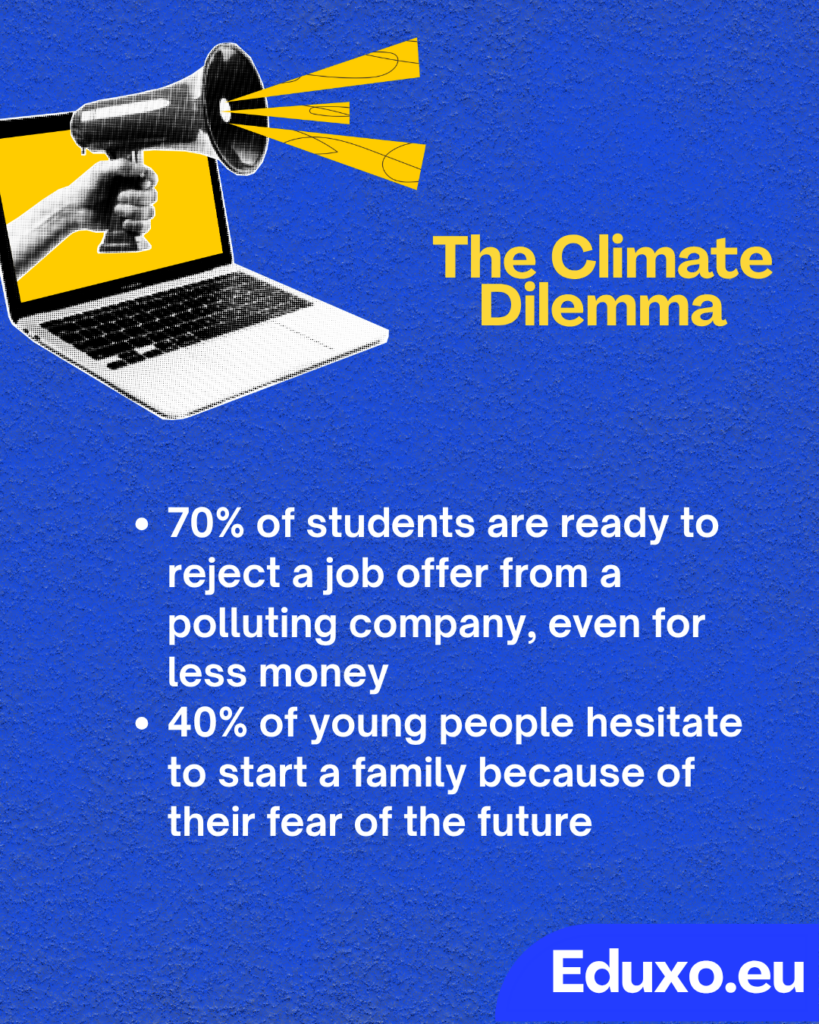
Many examples highlight this reality. More and more young people are giving up on the idea of having children; according to The Lancet, nearly 40% of young people hesitate to start a family because of the climate. There is also the dilemma faced by students who refuse to apply to companies that pollute. Choosing a career has become a moral crisis: should they prioritize financial security or the planet? An Opinionway survey confirms that nearly 70% of students would be willing to give up a job offer if the company’s practices were not eco-responsible, even if it meant a lower salary.
This is a global crisis that threatens our democratic structures, human rights, and the social contract. Despite all individual efforts to save the planet—such as sorting waste, eating less meat to reduce pollution, and using less electricity—young people feel that their daily sustainable choices are being wiped out by governmental inaction and multinational pollution. Stripping generations of a healthy future simply deprives young people of the right to choose their own lives and live in safety. This is where “no future without choice” gains its full political weight: a strong democracy is impossible without the guarantee that citizens’ choices actually matter in shaping the future.
From anxiety to agency
The only way to break this cycle of anxiety is to give real decision-making power and action back to young people. To dissolve this anxiety, we must move from solitary fear to collective action. Institutions must change their methods to genuinely include youth, rather than just listening to them without acting.
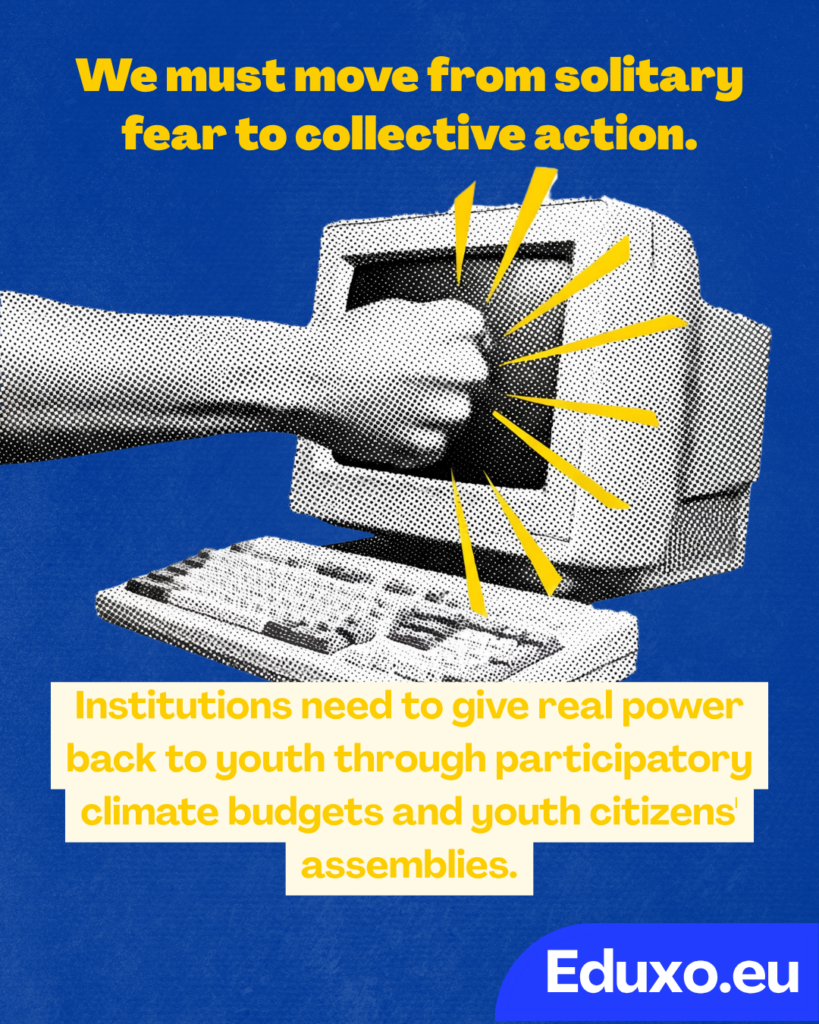
To achieve this, institutions can introduce real, tangible tools. First, they can create participatory climate budgets managed by young people at a local level, or youth citizens’ assemblies whose proposals must be voted on by parliaments. They can also support local community movements and grassroots projects. Giving young people the resources to co-design public policies for the ecological transition means giving them the choice to actively do something for their future.
Eduxo angle
This is precisely where Eduxo’s mission makes sense. We cannot ask a generation to reinvent tomorrow’s society with yesterday’s tools. Today’s civic education must adapt; it can no longer settle for just sharing frightening statistics. It must become the place where young people learn how to take action.
By equipping students with critical tools and practical skills to organize, debate, and influence decisions, the education system can transform anxiety into a collective force. For Eduxo.eu, giving a future back to youth means retraining them to realize they have the power to choose their battles, rather than just passively suffering through the crisis.
Climate anxiety will not disappear with empty promises or theoretical lessons on the environment. If society wants to secure a viable future, it must first give young people the power and the freedom to build it.
Article by: Alix-Ann Dumetz