
If you turn on the TV today, you will see dramatic headlines all over Europe using words like “empty cradle crisis” or “population decline.” European governments and leaders are panicking about birth rates. Their main obsession is the “aging population” and the fear that it will cause an economic collapse. For example, they worry there won’t be enough workers to pay for pensions or fund healthcare systems.
According to Eurostat in 2026, the fertility rate in the European Union has fallen to its lowest level ever, at 1.34 children per woman. The EU recorded 3.55 million births, which is a drop compared to 2023, when they counted 3.67 million. For context, a population needs a rate of 2.1% just to stay stable.
But the real problem is not in the numbers; it is in real life. The drop in birth rates is not because young people are selfish or lack willpower. The real issue is the collapse of living conditions: job insecurity, sky-high housing costs, and the rising cost of living. It is not that young people do not want children; it is that they lack a stable environment to raise them. Treating women and young people as “reproduction tools” is not the right way to save pension systems. Demographics are, above all, a matter of fundamental rights and reproductive justice. This means the right to choose whether or not to have children in a healthy and safe environment.
Numbers vs. Rights
We can see two different visions of this problem. On one side, there is a cold, mathematical approach that views people purely as numbers. Its logic is that people must have children to maintain economic growth and fix the pension system. On the other side, there is a rights-based approach. Its logic is that having a child is a private choice and a human right. The role of the State is not to demand births, but to guarantee a supportive environment for everyone.
As mentioned before, young people have not lost the desire to start a family. According to the OECD and the Eurobarometer, there is a glaring paradox: the majority of young adults in Europe want to have 2 or 3 children. Yet, they only have one, or none at all. This gap proves that the problem is not a lack of personal desire, but a structural roadblock.
This exact roadblock was highlighted at the European Demographic Summit. Experts at the event pointed out that facing the urge to fix falling birth rates, the response from some countries is completely wrong. Instead of tackling structural problems, some politicians try to make citizens feel guilty or restrict their rights—such as sex education, access to contraception, or abortion. This turns the topic of demographics into real reproductive injustice.
The Illusion of Choice
Today, starting a family has become an economic luxury. Our youth face total insecurity, temporary job contracts, the rising cost of living, and a housing crisis. According to European reports by FEANTSA (the European Federation of National Organisations Working with the Homeless), housing has become the number one reason young Europeans are pushed out. One out of four young adults (between 25 and 35) is forced to live with their parents, and those who do have a home must spend more than 40% of their salary on rent.
Maciej Smiechowski, Chair of the Executive Committee of Fertility Europe, noted that “young people lack confidence in the future.” To reverse this trend, governments must first rebuild trust by investing in affordable housing and stable jobs. But for now, under these conditions, choosing to have a child is more of a financial risk than a free choice.
Unequal Healthcare
Europe remains deeply unequal, even for those who do try to have children. First, access to fertility treatments is unfair. In some European countries like France, Belgium, and Denmark, the system pays for everything (reimbursing up to 4 or 6 full IVF cycles). Meanwhile, in countries like Ireland and Poland, they cover almost nothing. Public healthcare systems there barely fund any IVF cycles, so patients must turn to private clinics, where a single IVF cycle costs between €4,000 and €8,000.
Another important point is that medicine and society put all the responsibility of reproduction on women, treating it as “a women’s problem.” As soon as a couple struggles to have a child, the woman is almost always the one who undergoes the first painful medical tests and hormone checks. Yet, the WHO observes that men are responsible for about 50% of infertility cases. Better research into male infertility and a better sharing of responsibilities are necessary so that both women and men can try for a baby in the best possible conditions.
The Integration Angle
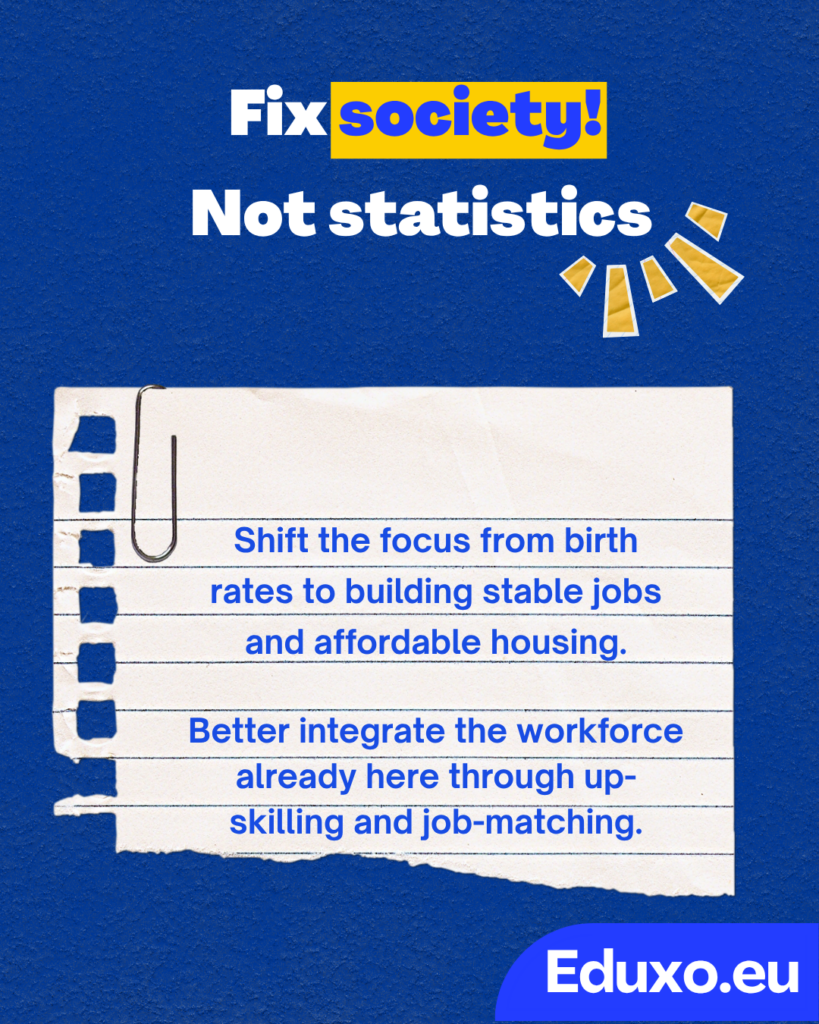
We need to stop focusing only on birth rates and start looking at how we integrate the people who are already here. Europe’s economic and demographic strength also depends on its ability to train and value its entire workforce without discrimination.
For example, Belgium passed a positive law that gives international students 12 months to look for a job after graduating. This is a great way to value their degree and help them enter the workforce. As discussed at the 2026 European Demographic Summit, efforts for up-skilling, re-skilling, and job matching must apply to local European populations, but also to foreign nationals and refugees.
The Eduxo Angle
For Eduxo.eu, young people are not statistics or economic tools. Decisions about tomorrow’s population affect us today. That is why we demand that youth have a seat at the decision-making table. Through civic education and active participation, we want to create policies that force no one but give every young person the security and freedom to build their future.
If Europe wants its birth rates to rise, the solution is not to make young people feel guilty, spread propaganda, or restrict women’s rights. Instead, we must fix society, so it becomes a safe place again. Once young people have stability and security, they will finally be able to freely realize their dream of starting a family.

Article by: Alix-Ann Dumetz