
Summer means sunshine, resting, holidays, swimming pools and the beach… But while these words mean freedom for some people, they mean oppression for others. Every summer, the same debate comes back. In the summer, the beach and the pool become places of political and social tension. For women, access to the water is highly watched by the State. For example, in France or Belgium, rules and laws are made to ban certain outfits like the burkini or swim shorts.
There is also the race to get the “summer body”—the perfect body for summer. This pressure becomes very strong during this period, both on social media and in magazines. Women are told to think about only one thing: having a perfect body! This kind of pressure and these fake images completely exclude other bodies from the right to be seen without being judged.
Today, society is going through big debates about inclusion (the rights of LGBTIQA+ people, systemic racism, religious freedom, or fatphobia). By looking at what happens at the beach or the pool, we can see if our society is really making progress towards more equality or not. The swimsuit is the “thermometer” that measures how tolerant our society is.
Historical Context: From 1920s modesty patrols to modern body policing
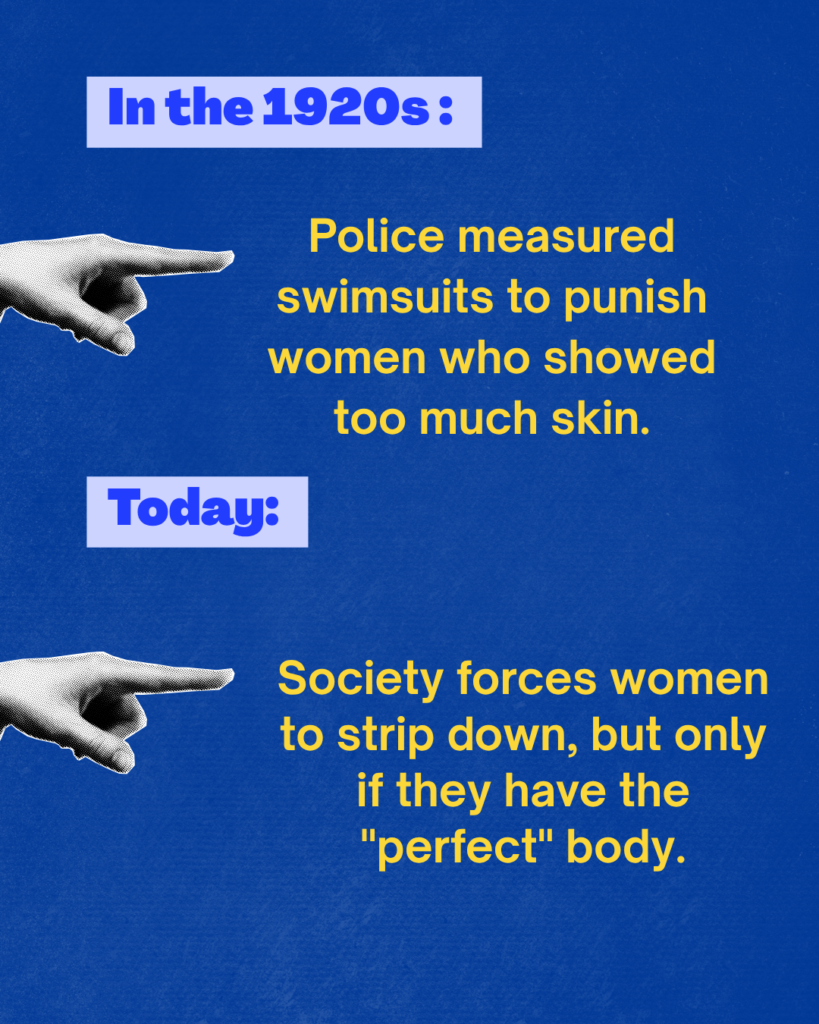
At the beginning of the 20th century, when women started going to public beaches, they were watched by the police. “Respectability” dictated which parts of their body women had to hide. In the United States and in Europe, police officers (called beach censors) walked on the beaches with tape measures. They measured if the distance between the knee and the bottom of the swimsuit was correct.
At the end of the 1910s, Los Angeles saw a series of arrests of swimmers and “beach-engagers” (people who keep the carefree, teenage freedom lifestyle on the beach, no matter their real age). The people arrested were caught wearing swimsuits on beaches, breaking a city law that made it illegal to wear swimsuits in public spaces.
But today, it is the opposite! In Western countries like Belgium, the standard for respectability, modernity and freedom is to wear a two-piece swimsuit or a bikini. However, the beach still has strict rules; it acts like a social filter. This is because the “acceptable body” must be thin, young, and non-disabled. If your body does not fit these criteria, the way people look at you makes you feel like you are bothering them.
Criminalizing Coverage Across European Pools
Controlling bodies turns into laws and bans. We see this, for example, with the hunting of the burkini in several European towns, like in France, but also in Germany and the United Kingdom. This is called the “criminalization of modesty”. In the 1960s, people celebrated the liberation of the body through the bikini. Today, women who choose to cover their bodies are punished.
According to Amnesty International, these bans are a form of systemic and racial discrimination. They limit women’s freedom of religion and expression. The real problem here is that politicians use excuses like hygiene to decide how women should show their bodies, and whether it is judged acceptable or not.
Another minority feels excluded from the norm: trans and non-binary people. Swimming pools are a source of discomfort for them. Having to choose between a swimsuit for men or for women, and facing the changing rooms, creates deep anxiety. For plus size or disabled people, the fear of judgment is also there. For example, the lack of inclusive sizes and the judging eyes of other swimmers make the beach or the pool places where exclusion is everywhere.
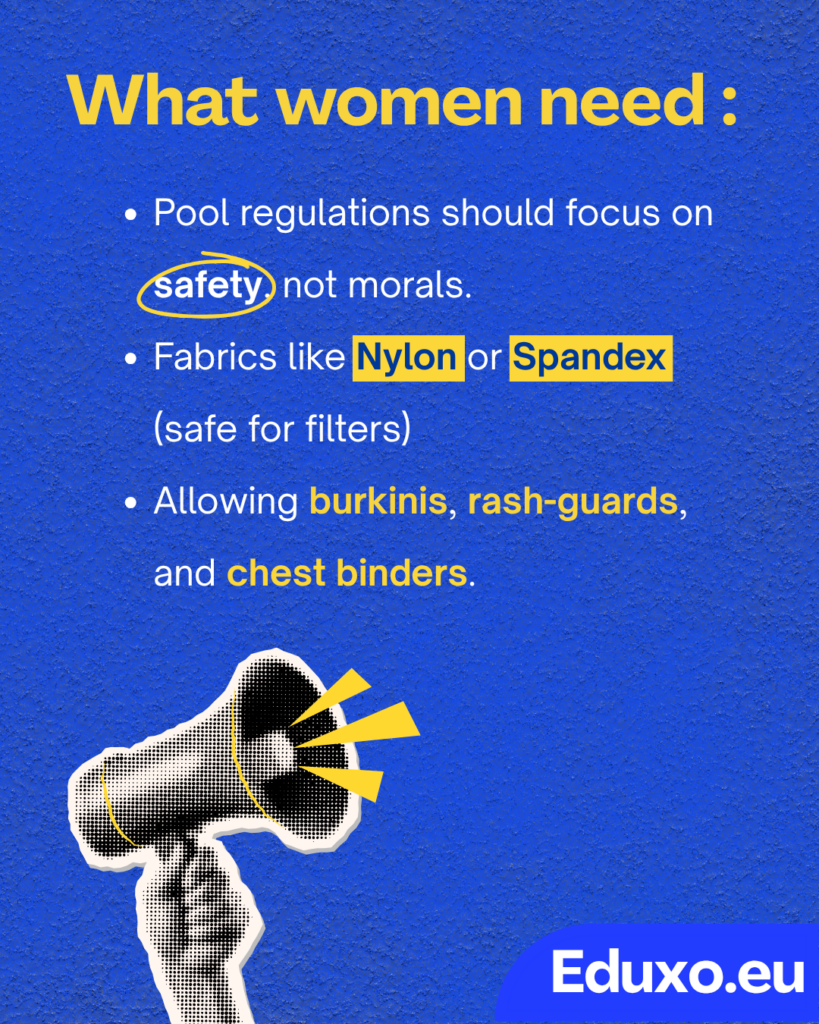
Society is changing. Minorities are becoming more visible and want their rights. But to do this, we need new rules inside swimming pools and on beaches so that everyone finally feels included. A pool or beach rule should only be based on safety and public health. For example, we should ask if the fabric of the clothing is safe for the water, like nylon or Spandex. These fabrics do not block the water filters and allow people to swim safely.
The NRPA (National Recreation and Park Association) is an organization that officially advises cities to adopt inclusive swimsuit policies. Their guide explains that pools should allow burkinis, rash-guards (t-shirts that protect against UV rays), swim shorts for everyone, and chest binders used by trans-masculine people. By changing these rules, the culture of watching people changes into a culture that is open to everyone, where public space adapts to all.
Why Body Autonomy Matters for Civic Education
Civic education is not just learned at school or by voting. It is lived every day in public spaces like the beach or the pool. These are often the first public spaces where young people experience living together in a community. If the rules and the way people look at them exclude minority bodies, what message are we sending to young people? Do we want to show them that democracy has borders and that it stops where the swimsuit begins? If yes, this will just create a feeling of rejection towards public spaces, and a loss of trust in the institutions that are supposed to protect them.
Controlling swimsuits affects all young women much more than we think. Eduxo places human rights and non-discrimination at the heart of its values. It defends the core European values: that everyone should have access to leisure activities without discrimination based on religion, body shape, or gender identity.
Fighting discrimination on beaches is not a “superficial” fight about summer fashion. It is a political fight to make sure that every young person, no matter their background or identity, feels legitimate, safe, and in their proper place in a democratic society. Defending this freedom means refusing to let any human being be pushed aside.
Article by: Alix-Ann Dumetz.
Lascia un commento